
Utility climbers in industrial projects: skills, responsibilities and safety standards
The image of a technician suspended on ropes, dozens of meters above the ground, immediately attracts attention. However, the spectacular part is the least important component of the profession.
In industry, utility climbers are not people who simply reach hard-to-reach places. They are rope access technicians who use rope access to perform work with well-defined technical, operational and safety requirements specific to industrial climbing projects.
They may inspect a metal structure, install equipment, replace fasteners, apply a corrosion protection system, participate in a rigging operation, or install permanent fall protection systems.
The quality of the intervention depends on two categories of skills: the ability to work safely on the rope and the qualification required for the technical operation performed. A high-performance utility climbing team combines these skills to efficiently perform complex work at height.
Who are utilitarian climbers?
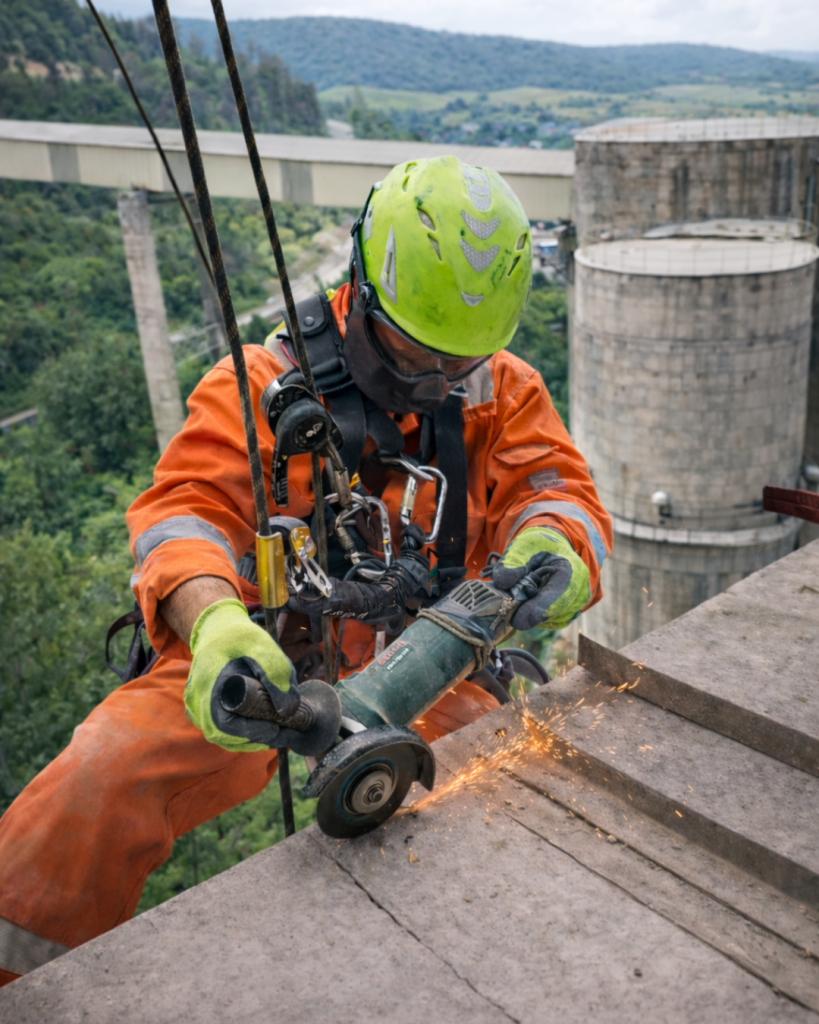
Utility climbers are technicians trained to access, move, and position themselves in areas at height or in configurations difficult to reach by conventional methods.
They use rope systems, descent and ascent devices, belts, connectors, anchors and auxiliary equipment to reach the working position.
The term "climber" may give the impression that the profession is an extension of sport climbing. In reality, the two activities have different objectives.
In industrial mountaineering:
- access is planned;
- the systems are configured for work;
- operations are performed in teams;
- equipment is checked and registered;
- risks are assessed;
- the area is controlled;
- there must be a rescue solution;
- the result of the work must be verified and documented.
Sportsmanship is no substitute for professional training for working at height. Professional utility climbers follow strict procedures and standards that guarantee the safe conduct of interventions.
What do utility climbers do in the industrial environment?
Their activity is much more diverse than facade maintenance.
In a factory or industrial facility, utility climbers and height technicians can intervene to:
- checking metal structures;
- inspecting joints;
- replacement of screws and fasteners;
- equipment installation;
- installation of technical routes;
- works on pipelines;
- application of anti-corrosion treatments;
- industrial painting;
- locksmith work;
- welding performed by qualified personnel;
- installation of fall protection systems;
- checking roofs and facades;
- visual inspections;
- support for lifting operations;
- interventions in areas with limited access;
- photographic documentation.
In addition to industry, professional utility climbers can work in energy, infrastructure, the maritime sector, logistics centers, commercial buildings, and facility management projects.
A utility climber cannot automatically perform every task
Rope access training does not automatically provide qualification for welding, electricity, NDT inspections, mechanical assembly or other specialized activities.
Two levels of competence must be verified for each project.
Access authority
The rope access technician must know:
- use of equipment;
- system configuration;
- ascent and descent;
- overcoming obstacles;
- positioning;
- changing strings;
- use of protection systems;
- emergency procedures;
- rescue techniques appropriate to his role.
Professional competence
The operation may require:
- welder qualification;
- locksmith skills;
- electrical training;
- authorization for certain equipment;
- inspector certification;
- training for non-destructive examination methods;
- rigging skills;
- knowledge of chemical products;
- confined space training;
- preparation for environments with special requirements.
A well-rounded utility climbing team combines these skills depending on the project. That's why utility climbers work together with other specialists to safely and efficiently execute complex industrial climbing jobs.
Why do utility climbers work in teams?
Working in isolation is incompatible with the principles of a professional rope access intervention.
A utility climbing team must be able to:
- check the systems;
- communicate constantly;
- control the area;
- manage materials;
- observe changes in the site;
- stop work in the event of a risk;
- intervene in an emergency situation.
The size and structure of the team are determined based on the working method, location, type of operation and rescue plan.
A complex project may include, in addition to professional utility climbers:
- coordinator or supervisor;
- HSE manager;
- welder;
- locksmith;
- electrician;
- inspector;
- rigger;
- personnel for area control;
- representatives of the beneficiary.
Collaboration between rope access technicians and other specialists allows for the safe execution of complex industrial climbing projects.
How do you prepare for a work day?
The activity does not begin the moment the technician enters the rope.
Before each intervention, the following are checked:
- site conditions;
- changes from the initial assessment;
- the condition of the anchorages;
- access systems;
- individual equipment;
- tools;
- materials;
- communications;
- delimitation of the area;
- work permits;
- interaction with other teams;
- weather conditions, when relevant;
- availability of rescue equipment.
Every utility climbing team must know the task, roles, risks, and criteria for stopping the activity.
If conditions arise that were not assessed, the work must be reassessed before continuing. This step is essential for all industrial climbing projects and for the safe conduct of work at height.
What does a real safety culture mean?
Safety is not limited to wearing a seat belt or completing paperwork.
A solid culture requires that each of the utility climbers:
- understand why a measure exists;
- checks equipment before use;
- communicates non-conformities;
- does not improvise;
- does not accept the pressure to work in unsafe conditions;
- knows his limits;
- stops the activity if the risk cannot be controlled;
- participates in the analysis of incidents and lessons learned.
Kreativ Alpin presents its working principles through four clear commitments:
- does not intervene without risk assessment;
- does not improvise solutions in the field;
- does not compromise safety for speed;
- does not work without clear procedures.
These principles are relevant because the pressure for quick completion is one of the most common causes of poor decisions in industrial climbing projects.
How are tools and materials controlled?
A technician at height must secure not only his own position, but also the equipment he uses.
Tools, dismantled items and materials must be managed to prevent them from falling.
Measures may include:
- tool clamping systems;
- closed containers;
- transport bags;
- controlled paths for lifting and lowering;
- delimitation of the lower area;
- inventory of objects;
- coordination of material transfer;
- additional protections for sensitive areas.
In industrial climbing projects, falling object control protects both personnel and the beneficiary's facilities and equipment.
How is the equipment checked?
Personal equipment used by utility climbers must be checked before each use and during established periodic inspections.
Every technician for work at height must aim for:
- wear;
- the cuts;
- deformations;
- corrosion;
- the functioning of mechanisms;
- contamination;
- component compatibility;
- legibility of markings;
- history of severe stress.
Any equipment that raises suspicions must be immediately withdrawn from use until its condition is clarified.
Kreativ Alpin uses certified equipment, periodically checked, and ensures traceability of equipment, personnel, and execution stages for each project.
Why is rescue planning mandatory?
A technician who is suspended and unable to move must be recovered in a controlled manner.
The rescue plan must be:
- adapted to the location;
- understood by the entire team;
- supported by the necessary equipment;
- compatible with the access system;
- possible to apply in real conditions;
- correlated with access to medical services.
All professional utility climbers must know the roles they play in emergency scenarios.
Rescue should not be improvised after the incident occurs, but planned before the intervention begins.
What role does supervision play?
Supervision ensures coordination of the access system and maintenance of operational discipline during the intervention.
The person leading the activity must monitor:
- implementation of the working method;
- compliance with responsibilities;
- systems configuration;
- the condition of the area;
- communication between team members;
- changes occurring in the field;
- rescue preparation;
- stopping work when conditions change.
Utility climbers and facility management
In the field of facility management, utility climbers play an important role in the periodic inspection and preventive maintenance of buildings and installations.
A utility climbing team can check:
- roofs;
- facades;
- skylights;
- rainwater systems;
- outdoor installations;
- branding elements;
- lighting;
- suspended structures;
- fall arrest systems;
- elements located above the traffic areas.
The advantage of a recurring collaboration is the accumulation of a history of the site. Successive reports allow the identification of defects and the planning of maintenance work before they become urgent interventions.
Through their experience in working at height, rope access technicians contribute to keeping buildings safe and reducing costs generated by unplanned repairs.
What personal skills are needed?
The profession requires more than physical fitness and lack of fear of heights.
A good utility climber must demonstrate:
- discipline;
- Careful;
- communication skills;
- technical thinking;
- self-control;
- ability to follow procedures;
- taking responsibility;
- attention to detail;
- availability for learning;
- ability to work in a team.
For professional utility climbers, experience should lead to more rigorous decisions, not to the elimination of control steps. Following procedures and effective teamwork are essential elements in any industrial climbing project.
How do you choose a team of utility climbers?
The beneficiary must verify both the skills of the utility climbers and the way in which the company organizes and coordinates the interventions.
The essential questions are:
- Do technicians have the necessary training for access?
- Do they have the technical qualifications required for the job?
- Who coordinates the team?
- Is there a risk assessment?
- Is there a working method?
- Is there a rescue plan?
- How is the equipment checked?
- How are the tools secured?
- How is the work documented?
- Who is responsible for quality control?
A competent utility climbing team, but lacking the organization of a responsible company, is not enough for complex industrial projects. That is why experience, planning and compliance with procedures are as important as the technical training of the personnel.
The Kreativ Alpin Team
Kreativ Alpin works with professional, licensed and continuously trained utility climbers for complex industrial climbing interventions and work at height.
The company offers complete solutions for the energy sector, Oil & Gas, industrial platforms, infrastructure, commercial buildings and facility management projects.
The portfolio includes:
- industrial access;
- technical inspections;
- assembly of metal structures;
- welding;
- industrial maintenance;
- fall arrest systems;
- rigging and lifting;
- decommissioning;
- facility management.
This approach is important because beneficiaries do not only need people who can reach heights, but also technicians for work at height capable of correctly and safely executing the technical operations for which they have been mobilized.
Frequently Asked Questions About Utility Climbers
Utility climbers perform inspection, maintenance, assembly, repair, and intervention work in difficult-to-reach areas, using professional access and rope positioning systems.
Not automatically. For welding, electricity or other specialized activities, additional professional qualifications are required, in addition to specific rope access training.
No. Professional interventions are carried out by a utility climbing team so that systems can be checked, the area controlled and the rescue plan can be applied if necessary.
Depending on the project, rope access technicians use ropes, belts, ascending and descending devices, safety systems, connectors, anchors, helmets and equipment dedicated to rescue operations.
Professional utility climbers work based on a rescue plan adapted to the site, use dedicated equipment and are trained to manage emergency situations, so that each intervention is carried out in maximum safety conditions.