
- Seoai
- Utility mountaineering, Industrial work at height
- 0 Comments
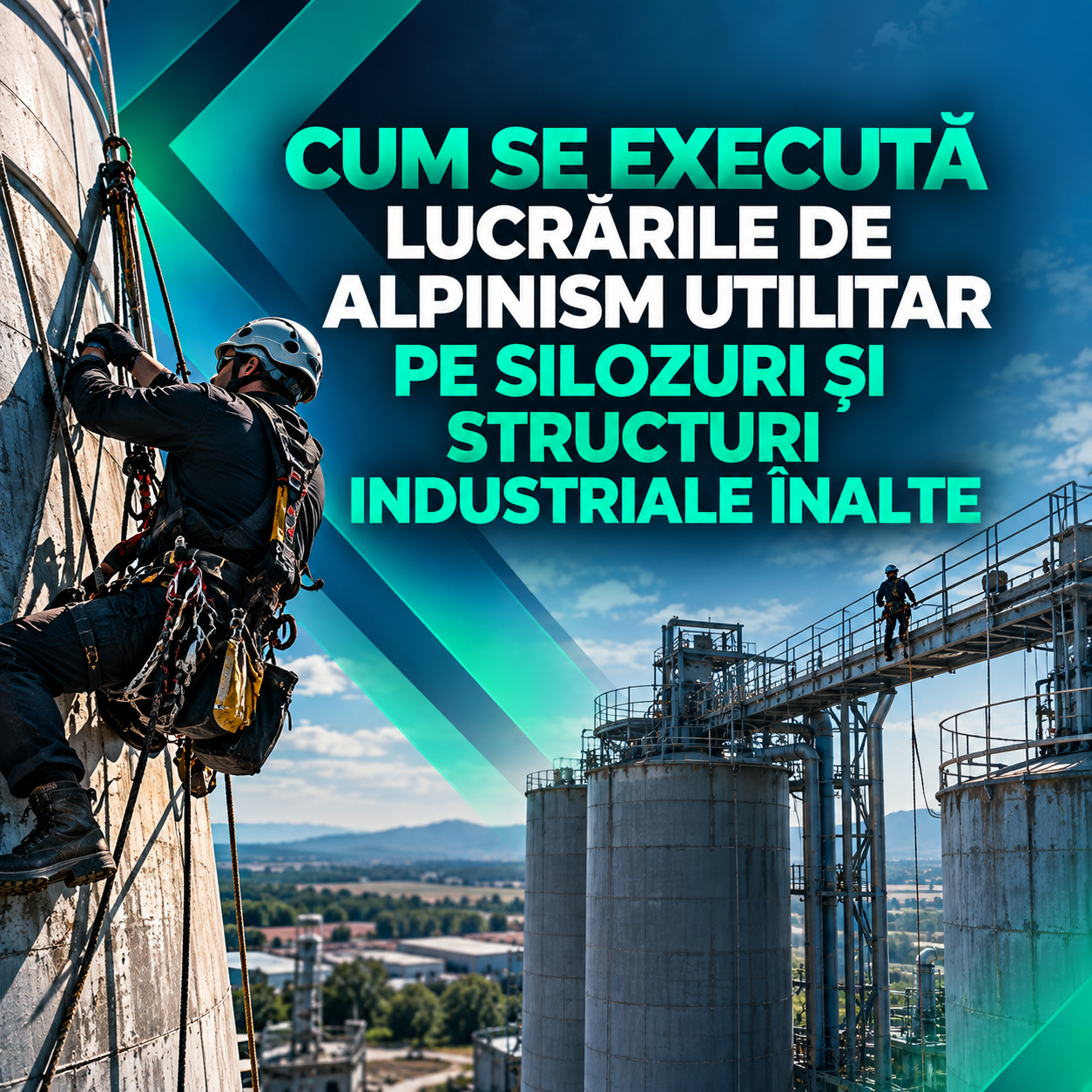
Silos, industrial bins, tanks and large metal structures require periodic inspections and interventions to maintain safety and functionality. Due to the height and difficult access, these works can represent significant challenges for industrial operators.
Why are silos and tall industrial structures difficult to maintain?
Industrial silos are used for storing various materials, such as grains, cement, powders and other bulk products.
These constructions can be of considerable height and include numerous technical elements that require periodic checks.
These include:
- Metal access and crossing walkways.
- Vertical ladders and technological platforms.
- Structural elements and metal joints.
- Industrial pipes and tubing.
- Material transportation and distribution systems.
- Ventilation and filtration equipment.
- Fall protection systems.
- External components exposed to corrosion.
Over time, these components can be affected by corrosion, vibrations, temperature variations, humidity and mechanical stress.
Depending on the materials stored and the industrial process, there may be additional risks, such as the accumulation of combustible dust, exposure to hazardous substances, or contact with operating equipment.
The particularity of working on silos is that access to heights must be analyzed together with the risks of the industrial facility.
For example, an intervention on a walkway between two silos may require both fall protection measures, verification of the stability of the structure, and coordination with nearby technological activities.
What utilitarian climbing work can be performed on silos?
Utility mountaineering can facilitate access for several categories of industrial work.
1. Technical inspections of silos and metal structures
Technical inspections are essential for early identification of damage.
In the case of silos, certain components are located at heights where direct inspection may be difficult.
Through rope access techniques, specialized personnel can get close to the elements that need to be inspected.
Depending on the project requirements, checks may include:
- Visual identification of areas affected by corrosion.
- Checking the apparent condition of metal joints.
- Identification of cracks, deformations and visible damage.
- Checking the supporting components.
- Assessment of the condition of walkways and platforms.
- Photographic documentation of defects.
When advanced checks are required, non-destructive testing (NDT) methods can be used, performed by competent personnel.
These may include ultrasonic, liquid penetrant, or magnetic particle examinations, depending on the material being analyzed and the defects being tracked.
It is important to note that a visual inspection performed by a utility climber does not replace the expertise of a structural engineer when it is necessary to assess the strength of the construction.
Kreativ Alpin offers services technical inspections and height expertise, including checks of metal structures and hard-to-reach industrial elements.
2. Repairs and reinforcements of industrial structures
Over time, the metal structures of silos may require repair or reinforcement work.
These may include elements such as crossing walkways, access platforms, metal supports and various auxiliary components.
Depending on the technical design and the qualifications of the personnel, interventions may include replacing components, installing fasteners, or performing local repairs.
In the case of works that affect the load-bearing capacity of the structure, the intervention must be carried out according to the approved technical documentation and under the responsibility of competent specialists.
3. Cleaning and anti-corrosion protection of silos
The external surfaces of metal silos are permanently exposed to environmental factors.
Humidity, temperature variations and substances present in the industrial atmosphere can promote the occurrence of corrosion.
To prevent degradation, surface preparation work and application of anti-corrosion protection systems may be necessary.
These may include mechanical cleaning, removal of damaged layers, and application of protective coatings.
The method used must be chosen depending on the material, surface condition and specific objective conditions.
In environments where combustible dusts or other potentially explosive atmospheres exist, surface preparation operations require additional fire and explosion prevention measures.
4. Installation and replacement of industrial equipment
Silos may include technical equipment located at height, which requires maintenance or replacement.
Examples include sensors, ventilation system components, pipes, metal supports, and safety systems.
Utility climbers can provide access and positioning for certain assembly operations.
For heavy items, lifting and handling must be carried out using lifting systems designed and verified for the respective loads.
Worker access systems should not be confused with industrial lifting equipment.
More information about these activities is available in the section industrial assembly and installations at height.
How is utilitarian climbing work performed on silos?
The execution of an industrial utility climbing work involves several stages, starting with the analysis of the objective and ending with the verification and documentation of the intervention.
Silo technical assessment and risk identification
Before starting work, the technical team must analyze the characteristics of the structure.
The height, configuration of the silo, access to intervention points and operating conditions are evaluated.
Also, potential obstacles and hazards near the work area are identified.
In the case of an industrial silo, the analysis may include:
- The apparent condition of the structure and the availability of technical documentation.
- The existence of adequate anchor points.
- Possibility of using alternative platforms or equipment.
- Risk of falling objects.
- The presence of machinery and technological installations.
- Exposure to dust, chemicals or hazardous atmospheres.
- Weather conditions and the influence of wind.
Based on the evaluation, it is determined whether utilitarian climbing is the appropriate method.
According to GD 1146/2006, rope access and positioning may only be used when the risk assessment shows that the work can be performed safely and the use of safer work equipment is not justified.
Intervention planning and documentation preparation
After the initial assessment, it is determined how the work will be carried out.
Planning should include the method of access, equipment, personnel responsibilities, protection of surrounding areas, and emergency procedures.
For industrial purposes, coordination with operator representatives is also necessary.
This collaboration is important when work is carried out near operating facilities.
Depending on the risks, it may be necessary to isolate some equipment, authorize the intervention, and establish special access conditions.
Documentation may include risk assessment, work procedure, rescue plan and work permits applicable to the site.
Checking anchors and preparing equipment
One of the essential elements of utilitarian mountaineering is the anchor system.
Anchor points must be evaluated in relation to the demands that may arise during work and a possible rescue operation.
The fact that a metal structure appears solid does not automatically mean that it can be used as an anchor point.
The systems must be established by competent personnel, based on the technical characteristics of the structure and the requirements of the equipment used.
Personal protective equipment, including harnesses, ropes, and devices used for access and belaying, is also checked before the intervention.
right IRATA International Code of Practice, planning, personnel competence, supervision and equipment checking are fundamental components of safe rope work.
Organizing the work area
Before technicians begin the intervention, the area must be prepared and properly demarcated.
A significant risk is represented by the possibility of falling tools, materials or loose components.
To prevent accidents, exclusion zones and protection measures for people at ground level are established.
The organization must also take into account the movement of personnel, vehicles and industrial equipment.
When access is made near technological lines, dangerous interference between the activity of climbers and production processes must be avoided.
Stage 5. Execution of works at height
After completing the checks and authorizing the start of work, the technicians can execute the planned intervention.
Depending on the project, the activity may involve visual inspections, assembly, repairs or maintenance.
During the work, the team must maintain communication and follow established procedures.
Any significant change in working conditions may require stopping the intervention and reassessing the risks.
For example, the occurrence of strong winds, changes in the operation of a technological installation, or the identification of an unstable structural component may require a change to the initial plan.
The goal is to complete the work without compromising the safety of personnel or the operation of the industrial facility.
Verification and documentation of works
At the end of the intervention, the operations performed and their compliance with the project requirements are verified.
Depending on the nature of the work, documentation may include photographs, technical reports, inspection results, and recommendations for further maintenance.
For structural repairs, acceptance must include the checks and documents provided for in the technical design.
Proper documentation allows the industrial operator to track the history of interventions and plan future work.
Working inside silos requires special safety measures
Working inside a silo is different from working on its exterior surface.
In certain situations, the interior of the silo may be classified as a confined space or restricted access space, with additional hazards compared to regular work at height.
Possible risks include oxygen deficiency, toxic gas buildup, fires, explosions, and burial in stored materials.
In grain silos, moving material can quickly entrap and bury a person.
Also, the accumulation of combustible dusts can generate explosive atmospheres.
The British Occupational Safety and Health Authority, HSE, cites grain silos among examples of confined spaces with specific risks.
For these works, the recommendation is to avoid entry whenever intervention can be carried out from the outside. When entry is necessary, specific risk control measures and rescue procedures must be applied.
Depending on the situation, checking the atmosphere, ventilation, isolation of energy sources and permanent external surveillance may be necessary.
The risks associated with grain silos are also presented by OSHA in the Grain Storage and Handling Facility Safety Guide. This represents an international technical reference, not directly applicable legislation in Romania.
Important: Rope access does not eliminate the dangers of a confined space. Working inside silos requires additional assessments and measures compared to outside interventions.
Real example from the Kreativ Alpin portfolio: strengthening a walkway between silos at 47 meters
A relevant example of the complexity of industrial work at height is the project documented in the Kreativ Alpin portfolio under the name „"Consolidation works of the silo crossing walkway at elevation 47 m"”.
The project highlights the company's experience in interventions on industrial infrastructure elements located at height.
The walkways between silos play an important role in ensuring access between different areas of the facility.
They can be exposed to mechanical stress, vibrations and environmental factors, which is why the condition of the supporting elements and protective components must be monitored periodically.
Consolidation works require an approach that takes into account the characteristics of the structure, access conditions and technical documentation of the intervention.
In the case of this project, the public portfolio confirms the type of work and the elevation of 47 meters, without detailing the technical procedures or measurable results.
Project photos are available on the page Silo crossing walkway consolidation works at elevation 47 m.
This type of project demonstrates the importance of collaboration between height access specialists and personnel responsible for the execution and verification of industrial works.
What advantages can utility climbing offer for silo maintenance?
For certain interventions, rope access can offer operational advantages compared to the use of scaffolding or other equipment.
Access to hard-to-reach areas
Silos may have configurations that limit the use of lifting platforms.
Rope access can facilitate access to certain exterior elements without installing scaffolding over the entire height of the structure.
However, this method must be justified by risk assessment.
Mobilization adapted to specific interventions
For a local inspection or repair, using a specialized team can reduce the need for temporary infrastructure.
This advantage depends on the existence of adequate anchor points and the complexity of the intervention.
Potentially low operational impact
In some situations, exterior work can be organized without completely stopping production.
However, this is not possible in all projects.
If there are risks generated by equipment in operation, measures must be established to isolate or shut down the affected installations.
Flexibility for complex structures
Rope access techniques can be useful for certain industrial configurations with vertical elements, walkways, pipes and auxiliary structures.
For operations that require handling heavy materials or maintaining a working position for long periods of time, a lifting platform or scaffolding may be more appropriate.
What rules must be followed for industrial utility mountaineering?
In Romania, work at height is regulated by legislation on occupational health and safety.
An important normative act is Government Decision No. 1146/2006, which sets out the minimum health and safety requirements for the use of work equipment.
For rope access and positioning techniques, the regulatory act provides requirements regarding belay systems, equipment, training and supervision.
As a rule, the access system must include two separately anchored ropes, one for work and one for safety. Exceptions are limited to situations and conditions provided for by legislation.
The work must also be planned in such a way that it is possible to provide rapid aid in emergency situations.
The full text can be consulted on Legislative Portal – Government Decision 1146/2006.
At the international level, IRATA standards and guidelines provide recommendations for the management of rope access activities, the competence of technicians and the organization of work systems.
These recommendations complement good professional practices, but do not replace the legal obligations applicable in Romania.
How do you choose a utility climbing company for silo work?
For industrial projects, the choice of provider must take into account technical competence and risk management capacity.
It is recommended to check experience in similar projects, personnel qualifications and procedures used for working at height.
In the case of interventions on tall industrial structures, it is important that the company can coordinate the activity with the facility operator and the specialists responsible for the installations.
A professional offer must describe the proposed works, the method of access, the main execution conditions and the responsibilities of the parties.
How much does utility climbing work on silos cost?
The cost of utility climbing work on silos depends on the height, the complexity of the intervention, the accessibility of the structure, the specific risks and the estimated duration of the work.
There is no universal tariff applicable to all silos or industrial structures.
For example, a visual inspection may require different resources than reinforcing a metal walkway or performing repairs that involve lifting operations.
The total cost may be influenced by the need for specialized personnel, equipment used, mobilization, safety measures and possible operational restrictions.
For an accurate estimate, it is recommended to submit information about the objective, including the approximate height, type of structure, nature of the intervention, and photos of the work area.
Based on this information, a preliminary assessment and, if necessary, a technical visit can be carried out.
Frequently asked questions about utility climbing on silos
How is utilitarian climbing work performed on silos?
The work begins with the technical assessment of the silo and the identification of risks. This is followed by the choice of the access method, the planning of the intervention, the verification of the equipment and the organization of the work area. The operations are performed by competent personnel, according to established procedures, and finally the necessary checks and documentation are carried out.
What types of work can utility climbers perform on silos?
Utility climbers can provide access for technical inspections, maintenance, corrosion protection, assembly and certain repairs. The operations must be carried out by personnel who also possess the professional skills required for the respective work.
Can you work on silos without erecting scaffolding?
Yes, under certain conditions. Rope access techniques can allow interventions without the installation of extensive scaffolding. The choice must be justified by risk assessment and comparison with other available access methods.
Is utility climbing on tall industrial structures safe?
Utility mountaineering can be safely undertaken when the work is properly planned, personnel are competent, and equipment and procedures comply with applicable requirements. However, the activity involves risks that must be assessed and controlled.
Can silos be inspected without stopping production?
Some external inspections can be organised in parallel with the industrial activity, if the risk assessment allows it. For interventions near dangerous equipment or inside silos, technological shutdowns and isolations may be necessary.
What risks are there when working inside silos?
Possible risks include oxygen deficiency, hazardous gases, combustible dusts, mechanical equipment and burial in stored materials. Interventions should be analyzed according to the specific requirements of working in confined spaces.
At what height can utility climbers work?
There is no universal height limit for all rope interventions. The feasibility of execution depends on the configuration of the structure, anchorage systems, equipment, environmental conditions and the result of the risk assessment.
How long does a utility climbing job on a silo take?
The duration can vary from a one-time intervention to projects that require multiple stages of execution. The complexity of the work, site preparation and possible technological restrictions influence the final deadline.
What certifications do utility climbers need to have?
Personnel must meet legal requirements for training and competence for the work they are performing. Specialist certifications, such as IRATA, demonstrate training in rope access techniques but do not replace the qualifications required for other industrial operations.
How do I request a quote for work on industrial silos?
For a preliminary estimate, information about the location, type of silo, height, nature of the intervention and access conditions are useful. Photos and available technical documentation can help identify the right solutions.