
- admin
- Utility mountaineering
- 0 Comments
In utilitarian mountaineering, safety begins before the climber leaves the ground.
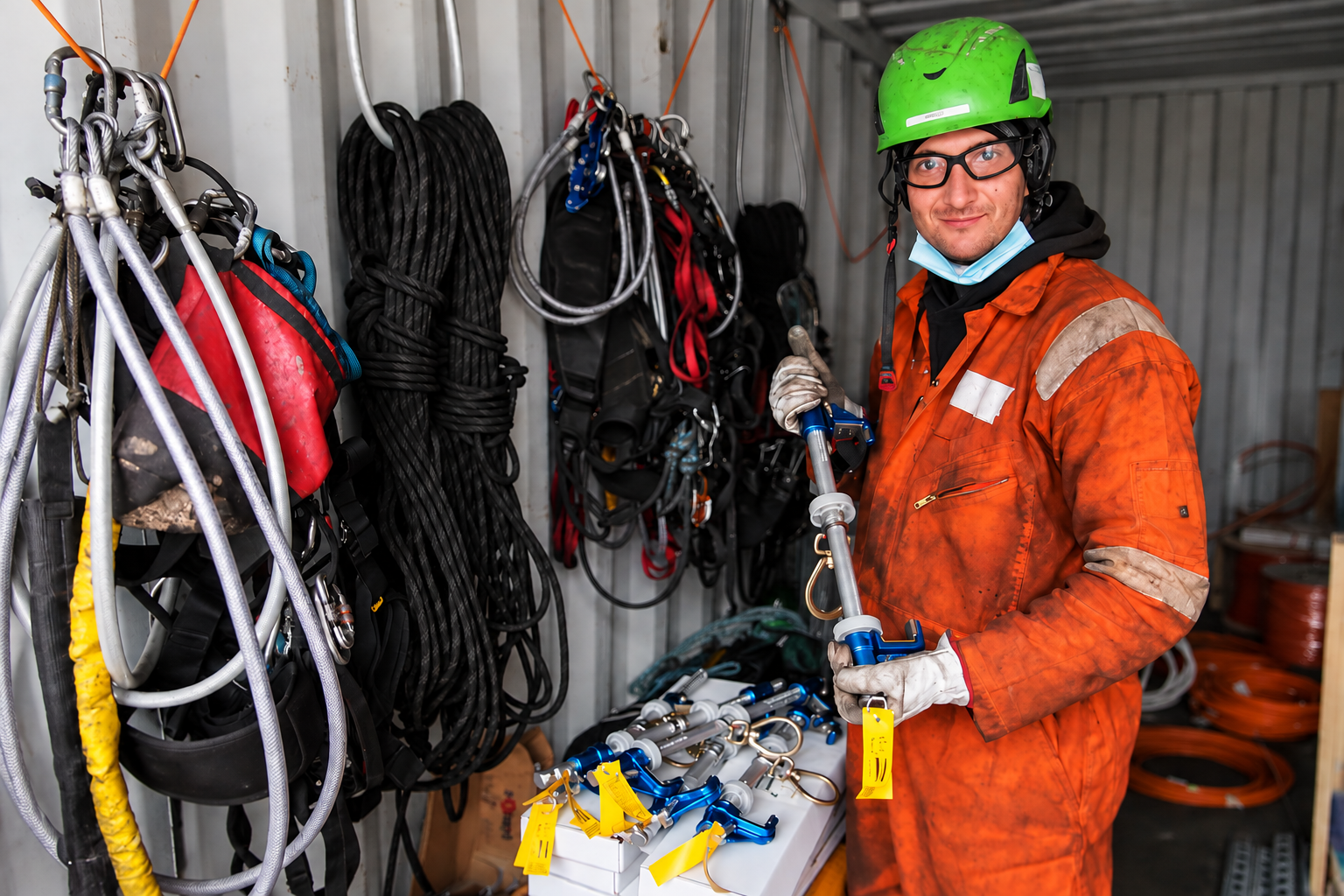
Harnesses, ropes, lanyards, carabiners, fall arrest devices and other personal protective equipment are essential components of the system used for working at height.
But the fact that a piece of equipment looks good at first glance does not automatically mean that it can continue to be used.
Wear, mechanical damage, contamination, corrosion, deformation or operational problems can affect the safety of a piece of equipment.
For this reason, periodic inspection of utility climbing equipment and PPE against falls from a heightis a fundamental component of safety management.
What does periodic PPE inspection mean?
Periodic inspection is a thorough examination of equipment, carried out to determine whether it continues to meet the criteria required for use.
It should not be confused with the verification that utility climbers performs it before using the equipment.
The pre-use inspection aims to quickly identify obvious problems.
Periodic PPE inspection is a formal and documented verification, carried out by a competent person, taking into account the applicable requirements and the manufacturer's instructions.
Kreativ Alpin has specific expertise in carrying out periodic inspections of PPE against falls from a height. The training covers equipment identification and classification, visual, tactile and functional inspection methods, defect identification, acceptance or withdrawal criteria and inspection documentation.
How often should equipment for working at height be inspected?
For many fall protection equipment, the familiar benchmark is periodic inspection every 12 months at most.
This rule should not, however, be interpreted as meaning that any equipment is automatically safe for 12 months.
The actual frequency must be established taking into account the manufacturer's instructions, the type of equipment, the intensity of use, the environment in which it is used and any events or damage that may have occurred during operation.
In the case of equipment used intensively in an industrial environment, checks may require a higher frequency.
And when there are suspicions regarding the safety of an equipment, it should not be kept in use just because the next inspection is not due.
What utility climbing equipment needs to be checked?
Depending on the type and manufacturer's instructions, inspections can target numerous categories of equipment used by utility climbers and by personnel carrying out work at height:
- safety harnesses and fall arrest harnesses;
- strings;
- stretch;
- energy absorbers;
- carabiners and other connectors;
- lowering devices;
- climbing devices;
- fall arrest devices;
- textile components;
- certain helmets for working at heights;
- other PPE intended for protection against falls.
However, it is important that each product be analyzed according to the manufacturer's documentation.
There are equipment for which the manufacturer may require that the inspection be carried out exclusively by the manufacturer or by a person or organization authorized by him.
The certification held within Kreativ Alpin explicitly mentions this limitation for products that require specific inspection qualifications or equipment.
What does the inspector check?
O inspection of utility climbing equipment it does not mean just a superficial visual examination of the product.
Depending on the equipment and manufacturer's instructions, the following can be followed:
Equipment identification – the model, manufacturer, markings and information necessary for traceability.
Textile elements – wear, cuts, abrasion, seam damage or material contamination.
Metal elements – deformations, cracks, wear, corrosion and other damage.
mechanisms – operation of moving components, locking and unlocking devices where applicable.
MARKING – the possibility of correct identification of the product and relevant information.
Equipment history – when it is available and necessary for the assessment.
Kreativ Alpin inspector training includes visual, tactile and functional inspection methods and the identification of wear, deformation, contamination, corrosion and other defects that may affect safety.
What happens if the equipment fails the inspection?
The purpose of the inspection is not to get a label or fill out a paper.
The goal is to determine the condition of the equipment.
Following the evaluation, it may be maintained in use, temporarily withdrawn for clarification, or permanently removed from use, as appropriate.
Documentation is equally important.
Inspection records contribute to equipment traceability, and specific inspector training includes completing inspection forms, registers and record documents.
Why is PPE inspection important for a utility climbing company?
For a utility mountaineering company, the equipment is a critical component of the work system.
A utility climber may have experience, qualifications, and a correct work procedure, but the safety of the entire system also depends on the condition of the equipment used.
This becomes even more important in the industrial environment.
In factories, halls, metal structures and other technical facilities, utility climbers may work near industrial machinery, installations and processes, which requires careful organization of the intervention and management of site-specific risks. This type of activity is already an important component of Kreativ Alpin's services.
PPE inspection does not replace pre-use checking
It is one of the most important distinctions.
Periodic inspection does not mean that the equipment no longer needs to be checked between inspections.
Before use, the user must monitor the condition of the equipment according to applicable procedures and instructions.
If there are doubts about the integrity or operation of an equipment, it must be treated accordingly without waiting for the next periodic inspection date.
Utility mountaineering equipment inspection by Kreativ Alpin
Kreativ Alpin expands its services in the area of utility climbing, industrial climbing and working at height through specific competencies for the periodic inspection of personal fall protection equipment.
Our inspector has completed specific training and demonstrated the necessary skills to carry out these inspections within the limits of their qualification and the manufacturer's requirements. The certification refers to Regulation (EU) 2016/425 and EN 365.
The specific certificate of competent person for the periodic inspection of PPE against falls from a height is associated with ALPINE CREATIVE and indicates a validity of 24 months from the exam on September 5, 2026.
Thus, practical experience in utility mountaineering and industrial work at height is complemented by a specialized competence in the control of equipment used for fall protection.
Do you have equipment for working at height that needs to be inspected?
If your company uses harnesses, ropes, lanyards, carabiners, fall arrest devices or other PPE for utility mountaineering and working at height, contact Kreativ Alpin.
We can analyze the type of equipment, the available documentation, and the possibility of performing the inspection within the limits of the competences and requirements established by the manufacturer.
Kreativ Alpin – utility mountaineering, industrial work at height and periodic PPE inspections.